Is Phone Spying Preventable?

In an increasingly digital world, the question of phone spying has become a significant concern. With the rise of sophisticated hacking tools like Pegasus, malicious actors can gain unauthorized access to personal data, communications, and even control over devices. This raises a critical issue: Is phone spying preventable? The answer is both yes and no. While certain security measures can significantly reduce the risks, no device is entirely immune to spying in today’s interconnected environment.

The Reality of Phone Spying

Phone spying refers to the unauthorized surveillance of a person’s phone activities, often through malware, unauthorized apps, or vulnerabilities in the phone’s operating system. Notably, spyware like Pegasus, developed by NSO Group, has demonstrated the capacity to infect smartphones without user interaction, collecting data, recording calls, and even turning on cameras and microphones remotely. According to a report by Amnesty International, this spyware has been used against journalists, human rights activists, and political figures, heightening concerns about privacy and security in the digital age .

Can It Be Prevented?

1. Awareness and Responsible Usage
The first line of defense is being aware of the risks and responsible device usage. Users should be cautious about the apps they download, avoid clicking suspicious links, and regularly update their devices. According to Edward Snowden, a whistleblower who revealed large-scale government surveillance, many people unwittingly compromise their own privacy by neglecting these basic security measures . He also points out that governments and corporations may exploit weak security settings to conduct mass surveillance .

2. Encryption and Secure Communication
End-to-end encryption (E2EE) is one of the most effective ways to protect phone communications. Encryption ensures that only the sender and the intended recipient can read messages, reducing the risk of interception. Apps like Signal and WhatsApp employ E2EE, making it difficult for third parties to access messages in transit. However, these measures are not foolproof, as attackers can still exploit vulnerabilities within devices themselves .

3. Software Updates and Patches
One of the leading causes of phone spying is outdated software. Phone manufacturers and software developers regularly release patches that fix known vulnerabilities, and failing to install these updates can leave devices exposed to malware attacks. In 2021, Apple issued a critical patch after Pegasus was found to exploit a zero-day vulnerability in iPhones, allowing attackers to install spyware without user interaction .

4. Trusted Sources for Apps and Services
Another preventive step is downloading apps only from trusted sources like the Apple App Store or Google Play Store. Sideloading apps from third-party websites or dubious sources increases the likelihood of installing spyware or malicious software. According to research from cybersecurity firm Kaspersky, nearly 30% of mobile malware infections result from apps downloaded outside of official app stores .

Limitations of Preventive Measures

1. Advanced Persistent Threats (APTs)
For well-funded and technically sophisticated adversaries, such as nation-states, standard security measures may not be enough. Advanced Persistent Threats (APTs) are tailored attacks that exploit zero-day vulnerabilities—previously unknown flaws in software that manufacturers have not yet patched. These attacks often bypass regular security measures, making them challenging to prevent .

2. Backdoor Access
Phone manufacturers and governments sometimes have backdoor access to devices for surveillance purposes. This is done under the guise of national security, as seen in the U.S. National Security Agency’s (NSA) mass surveillance programs, which were exposed by Edward Snowden in 2013 . The use of such backdoors means that, in certain cases, privacy cannot be guaranteed, as these vulnerabilities are deliberately placed within systems.

3. Supply Chain Attacks
An often-overlooked vulnerability is in the supply chain. As highlighted in the 2020 SolarWinds hack, attackers can target software or hardware during the manufacturing or shipping process, inserting spyware before the product even reaches the consumer. Supply chain attacks are notoriously difficult to detect and prevent, especially for end users .

Can We Secure the Future?

While perfect prevention might be unrealistic, constant vigilance, better encryption, and timely software updates can minimize the risks. Governments, too, have a role to play by enforcing stronger privacy laws and pressuring tech companies to prioritize security over convenience.

Conclusion
Phone spying is a serious threat in today’s world, but it can be mitigated through a combination of user awareness, robust encryption, timely updates, and cautious app usage. However, the ever-evolving nature of cyber threats means no one is entirely safe. Staying informed and vigilant is critical for anyone seeking to protect their digital privacy. While complete prevention may be impossible, reducing the risk to a manageable level is achievable with the right steps.

References

  1. Amnesty International. “NSO Group’s Pegasus Spyware Targeted Journalists, Activists Worldwide.” (2021).
  2. Snowden, Edward. Permanent Record. Macmillan, 2019.
  3. Kaspersky Lab. “State of Mobile Malware in 2020: Statistics and Insights.”
  4. Financial Times. “SolarWinds: How Supply Chain Attacks Work and Why They’re So Dangerous.” (2020).

A Future Ransomware Attack exploiting the CrowdStrike Incident Vulnerabilities

Timeline of Events

Day 1: Discovery and Initial Breach

08:00 AM
A group of sophisticated cybercriminals identifies a vulnerability in the CrowdStrike Falcon software, based on the incident from July 2024. They exploit an unpatched version running on the IT systems of a major metropolitan hospital and an international airline.

09:30 AM
The attackers breach the hospital’s network through a compromised endpoint, gaining access to the internal systems. Simultaneously, they infiltrate the airline’s network, targeting critical operational systems.

11:00 AM
Malware is quietly installed on both networks. The ransomware is set to initiate a coordinated attack designed to maximize disruption. The attackers spend the next few hours exploring the networks, identifying key systems, and ensuring they have control over backups and critical infrastructure.

Day 2: Attack Initiation

07:00 AM
The ransomware is activated across the hospital’s network, encrypting patient records, diagnostic equipment, and critical medical databases. Simultaneously, the airline’s systems are attacked, with operational software and booking systems being encrypted.

07:15 AM
Hospital staff discover that their systems are inaccessible. Alarms and diagnostic tools start malfunctioning, creating confusion and panic among medical personnel.

07:30 AM
At the airline’s main hub, boarding systems, check-in kiosks, and flight scheduling systems fail. Flights are delayed, and passengers are left stranded, unaware of the unfolding cyberattack.

Day 3: Escalation and National Impact

08:00 AM
News of the hospital’s IT outage spreads quickly. Emergency procedures are activated, and patients in critical care are transferred to other hospitals, causing strain on neighboring medical facilities.

09:00 AM
The airline cancels all flights from major airports due to the ransomware attack. Passengers are stuck in terminals, causing massive delays and overcrowding. The airline’s customer service lines are overwhelmed with calls.

10:00 AM
The attackers demand a ransom of $50 million in cryptocurrency to decrypt the hospital and airline systems. They threaten to release sensitive patient data and airline customer information if the ransom is not paid within 48 hours.

Day 4: Government and Public Response

08:00 AM
The government issues a national emergency declaration. Cybersecurity experts from federal agencies are dispatched to assist in resolving the situation.

09:30 AM
News outlets report on the ransomware attack, causing widespread public panic. The stock market reacts negatively, with shares in healthcare and airline industries plummeting.

11:00 AM
Hospitals nationwide are put on high alert. The Department of Health and Human Services coordinates with other hospitals to manage the overflow of patients.

01:00 PM
The airline’s CEO holds a press conference, apologizing for the disruptions and assuring the public that they are working to resolve the issue. The Federal Aviation Administration (FAA) is involved in managing the air traffic chaos.

Day 5: Crisis Management and Mitigation

08:00 AM
Federal cybersecurity teams begin working with the hospital and airline to contain the ransomware spread and assess the damage. Efforts are made to restore critical systems using backup data.

10:00 AM
The attackers release a sample of stolen data to demonstrate their seriousness. The hospital’s and airline’s reputations take a severe hit as the public fears for their personal information.

12:00 PM
Negotiations with the attackers are initiated, but progress is slow. Alternative plans are developed to restore systems without paying the ransom.

04:00 PM
A temporary workaround is implemented for the hospital to access basic patient care systems. The airline begins manually processing flight schedules to resume limited operations.

Day 6: Resolution Efforts and Aftermath

08:00 AM
Federal agencies successfully decrypt parts of the ransomware. The hospital’s critical systems are gradually restored, although many patient records remain encrypted.

09:00 AM
The airline resumes more flights, but a full recovery is still weeks away. Thousands of passengers are still affected, and compensations are being arranged.

12:00 PM
Public health advisories are issued to mitigate the spread of misinformation and panic. Government officials hold briefings to reassure the public and outline steps being taken.

Day 7: Recovery and Reflection

08:00 AM
Both the hospital and airline begin a thorough review of their cybersecurity measures. Plans for stronger defenses and better incident response strategies are developed.

10:00 AM
The government announces a new cybersecurity initiative aimed at critical infrastructure protection, emphasizing the need for advanced threat detection and response systems.

02:00 PM
The attack becomes a case study for cybersecurity experts worldwide, highlighting the importance of robust security protocols and the dangers of an expanded attack surface.

This fictional scenario, while hypothetical, demonstrates how vulnerabilities exposed in a significant incident like the CrowdStrike breach can lead to catastrophic consequences. The ripple effect of such an attack can disrupt essential services, create national chaos, and prompt a reevaluation of cybersecurity strategies across industries. It underscores the critical need for constant vigilance, advanced security measures, and comprehensive response plans to protect against the ever-evolving landscape of cyber threats.

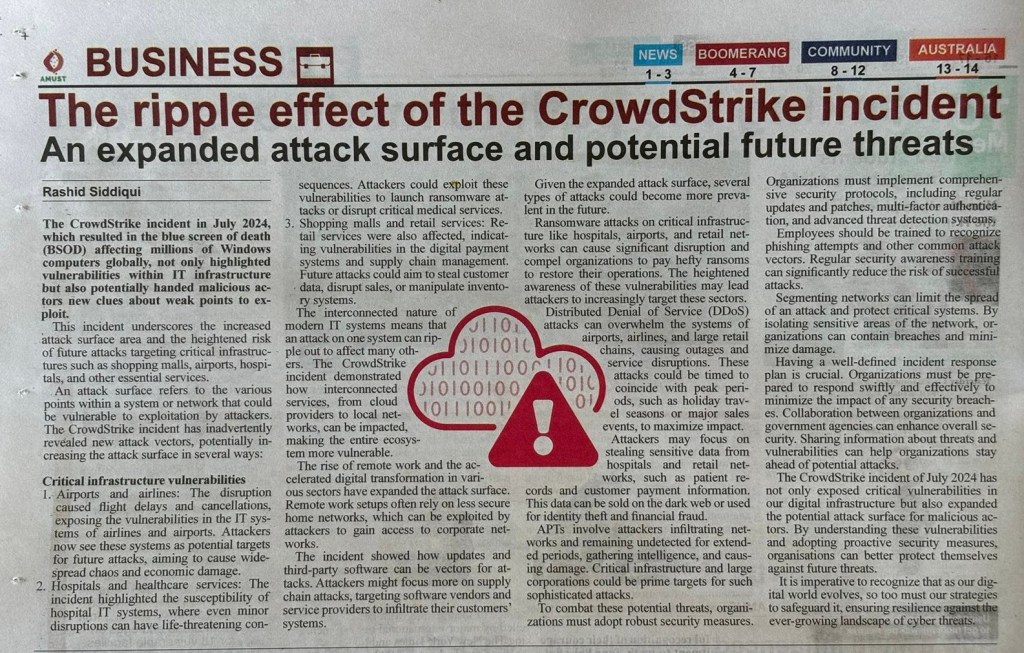
The Ripple Effect of the CrowdStrike Incident – An Expanded Attack Surface and Potential Future Threats

The CrowdStrike incident in July 2024, which resulted in the blue screen of death (BSOD) affecting millions of Windows computers globally, not only highlighted vulnerabilities within IT infrastructure but also potentially handed malicious actors new clues about weak points to exploit. This incident underscores the increased attack surface area and the heightened risk of future attacks targeting critical infrastructures such as shopping malls, airports, hospitals, and other essential services.

If you missed my previous blog explaining the CrowdStrike Incident, you can refer it here: Understanding the CrowdStrike Incident of July 2024

The Expanded Attack Surface

An attack surface refers to the various points within a system or network that could be vulnerable to exploitation by attackers. The CrowdStrike incident has inadvertently revealed new attack vectors, potentially increasing the attack surface in several ways:

Critical Infrastructure Vulnerabilities

  1. Airports and Airlines: The disruption caused flight delays and cancellations, exposing the vulnerabilities in the IT systems of airlines and airports. Attackers now see these systems as potential targets for future attacks, aiming to cause widespread chaos and economic damage.
  2. Hospitals and Healthcare Services: The incident highlighted the susceptibility of hospital IT systems, where even minor disruptions can have life-threatening consequences. Attackers could exploit these vulnerabilities to launch ransomware attacks or disrupt critical medical services.
  3. Shopping Malls and Retail Services: Retail services were also affected, indicating vulnerabilities in the digital payment systems and supply chain management. Future attacks could aim to steal customer data, disrupt sales, or manipulate inventory systems.

Increased Interconnectivity

The interconnected nature of modern IT systems means that an attack on one system can ripple out to affect many others. The CrowdStrike incident demonstrated how interconnected services, from cloud providers to local networks, can be impacted, making the entire ecosystem more vulnerable.

Remote Work and Digital Transformation

The rise of remote work and the accelerated digital transformation in various sectors have expanded the attack surface. Remote work setups often rely on less secure home networks, which can be exploited by attackers to gain access to corporate networks.

Supply Chain Attacks

The incident showed how updates and third-party software can be vectors for attacks. Attackers might focus more on supply chain attacks, targeting software vendors and service providers to infiltrate their customers’ systems.

Potential Future Attacks

Given the expanded attack surface, several types of attacks could become more prevalent in the future:

Ransomware Attacks

Ransomware attacks on critical infrastructure like hospitals, airports, and retail networks can cause significant disruption and compel organizations to pay hefty ransoms to restore their operations. The heightened awareness of these vulnerabilities may lead attackers to increasingly target these sectors.

DDoS Attacks

Distributed Denial of Service (DDoS) attacks can overwhelm the systems of airports, airlines, and large retail chains, causing outages and service disruptions. These attacks could be timed to coincide with peak periods, such as holiday travel seasons or major sales events, to maximize impact.

Data Breaches and Theft

Attackers may focus on stealing sensitive data from hospitals and retail networks, such as patient records and customer payment information. This data can be sold on the dark web or used for identity theft and financial fraud.

Advanced Persistent Threats (APTs)

APTs involve attackers infiltrating networks and remaining undetected for extended periods, gathering intelligence, and causing damage. Critical infrastructure and large corporations could be prime targets for such sophisticated attacks.

Mitigating the Risks

To combat these potential threats, organizations must adopt robust security measures:

Enhanced Security Protocols

Organizations must implement comprehensive security protocols, including regular updates and patches, multi-factor authentication, and advanced threat detection systems.

Employee Training and Awareness

Employees should be trained to recognize phishing attempts and other common attack vectors. Regular security awareness training can significantly reduce the risk of successful attacks.

Network Segmentation

Segmenting networks can limit the spread of an attack and protect critical systems. By isolating sensitive areas of the network, organizations can contain breaches and minimize damage.

Incident Response Planning

Having a well-defined incident response plan is crucial. Organizations must be prepared to respond swiftly and effectively to minimize the impact of any security breaches.

Collaboration and Information Sharing

Collaboration between organizations and government agencies can enhance overall security. Sharing information about threats and vulnerabilities can help organizations stay ahead of potential attacks.

Conclusion

The CrowdStrike incident of July 2024 has not only exposed critical vulnerabilities in our digital infrastructure but also expanded the potential attack surface for malicious actors. By understanding these vulnerabilities and adopting proactive security measures, organizations can better protect themselves against future threats. It is imperative to recognize that as our digital world evolves, so too must our strategies to safeguard it, ensuring resilience against the ever-growing landscape of cyber threats.

Important References

  1. “Security Engineering: A Guide to Building Dependable Distributed Systems” by Ross Anderson
  2. “Building Secure and Reliable Systems: Best Practices for Designing, Implementing, and Maintaining Systems” by Heather Adkins, et al.
  3. “Zero Trust Networks: Building Secure Systems in Untrusted Networks” by Evan Gilman and Doug Barth
  4. Research Paper: “Network Segmentation: Architecture and Use Cases” by the SANS Institute

Understanding the Fundamentals of Information Security: A Comprehensive Recap

Hello friends. In this blog post, we will be doing a quick recap, a sort of revision, of what we have discussed so far about the security framework, information security policy, and the CIA triad—confidentiality, integrity, and availability. This recap is based on Visio drawings I developed while preparing for CISSP some time back. These drawings serve as a memory map to consolidate all the concepts in one place. Let’s dive in, and hopefully, this will be more interesting than previous discussions, thanks to its pictorial representation.

Security Framework and Policy Development

Firstly, we select a security framework and then develop an information security policy around this framework. Our policy will focus on a framework or a set of frameworks, depending on the business requirement. This decision is explained in a three-step process:

  1. Security Initiation: We choose a framework based on the type of business we have, whether it is telco, healthcare, financial institution, or government organization. This is a crucial step.
  2. Security Fine-Tuning: Security is refined using security evaluation, which could include risk assessment, vulnerability assessment, or penetration testing. We tailor the initial security framework to suit the specific needs of the organization.
  3. Policy Conception: As a result of the first two steps, the organization’s security policy is conceived.

A security framework provides a starting point for implementing security. When designing security, we need to ensure:

  • Security is treated as an element of business management.
  • It supports the organization’s objectives, mission, and goals.
  • Security is a continuous journey, evolving with business requirements.
  • It is legally defensible and cost-effective.

The CIA Triad: Confidentiality, Integrity, and Availability

The CIA triad is the essence of the information security policy. It consists of three critical components:

  • Confidentiality: Prevents unauthorized access and protects the secrecy of data.
  • Integrity: Ensures the authenticity and genuineness of data.
  • Availability: Ensures that services, resources, or data are accessible to authorized users.

Each component is crucial, and their importance may vary depending on the specific business context.

Confidentiality

Confidentiality aims to prevent or minimize unauthorized access, protecting the secrecy of data or resources. Key terms related to confidentiality include:

  • Sensitivity: The quality of data, often used in government organizations.
  • Discretion: The act of deciding on the disclosure of documents.
  • Criticality: Signifies the importance to business.
  • Concealment: Preventing disclosure, sometimes through security by obscurity.
  • Secrecy: Keeping data secret.
  • Privacy: Pertains to personally identifiable information.
  • Seclusion and Isolation: Storing data off-site (seclusion) or keeping it separate (isolation).

Integrity

Integrity is about maintaining the authenticity and genuineness of data. Terms associated with integrity include:

  • Accuracy: Having precise and correct values.
  • Truthfulness: The true reflection of reality.
  • Validity: Data should be factually correct and logically sound.
  • Accountability: Responsibility for the integrity of the data.
  • Responsibility: Having control.
  • Completeness: Providing a complete and truthful picture.
  • Comprehensiveness: Covering the entire scope of the intended objective.

The goal of integrity is to facilitate authorized changes while preventing unauthorized alterations, protecting the reliability and correctness of data.

Availability

Availability ensures that services, resources, or data are accessible to authorized users. Key terms related to availability include usability, accessibility, and timeliness. The goal of availability is timely and uninterrupted access to objects for authorized subjects.

Reverse of CIA: Disclosure, Alteration, and Destruction

The inverse of the CIA triad is DAD: Disclosure, Alteration, and Destruction. Disclosure involves unauthorized access, alteration involves unauthorized changes, and destruction makes data unavailable.

Additional Concepts: Non-repudiation and Authentication

Non-repudiation and authentication are also crucial concepts:

  • Authentication: Verifies the source, ensuring that the person claiming to be someone is actually that person.
  • Non-repudiation: Ensures that the sender cannot deny their participation in the communication.

References for Further Reading

  • Books:
  • Whitman, M. E., & Mattord, H. J. (2018). Principles of Information Security. Cengage Learning.
  • Stallings, W. (2019). Network Security Essentials: Applications and Standards. Pearson.
  • Research Papers:
  • Schneier, B. (1999). Attack Trees. Dr. Dobb’s Journal of Software Tools.
  • Bishop, M. (2003). What is Computer Security?. IEEE Security & Privacy, 1(1), 67-69.
  • Articles:
  • “Understanding the CIA Triad” (2020). Infosec Institute. Link
  • “The Importance of Confidentiality, Integrity, and Availability in Information Security” (2021). CSO Online. Link
  • News:
  • “Data Breaches and the CIA Triad: Lessons from Major Incidents” (2022). Security Magazine. Link

By understanding and applying these principles, organizations can create a robust information security policy that supports their business objectives and adapts to changing requirements.

Thanks for reading. If you have feedback or comments, please put them in the comment section so I can improve further.

Understanding CIA and Its Universe: A Deep Dive into Information Security

Welcome back! In this blog post, we’ll continue our discussion on the fundamental principles of information security, focusing on the CIA triad—Confidentiality, Integrity, and Availability—and its inverse, DAD (Disclosure, Alteration, and Destruction). We’ll also delve into related concepts like non-repudiation, privacy, and examples that illustrate these terms.

The CIA Triad

Confidentiality

Confidentiality ensures that information is accessible only to those authorized to access it. To illustrate, consider two friends, A and B. If A sends a 100-dollar check to B in an envelope, only B should be able to open and use it. This is the principle of confidentiality. If someone else intercepts the message, confidentiality is breached.

Related Concepts:

  • Sensitivity: Reflects the quality of the message.
  • Criticality: Indicates the importance of the message for business or government operations.
  • Secrecy: Keeping the message secret, typically through encryption.
  • Privacy: Related to personally identifiable information like addresses and medical records.
  • Seclusion: Information kept off-site with access control.
  • Isolation: Information kept in a separate place.

Integrity

Integrity ensures that the information remains unaltered during transit. For example, if A sends 100 dollars to B, the amount should not change to 1000 dollars. If the information is altered, the principle of integrity is compromised.

Related Concepts:

  • Accuracy: Precision of the message.
  • Truthfulness: True state of the message.
  • Validity: Logically sound and factually correct.
  • Comprehensiveness: Completeness of the data.

Availability

Availability ensures that information and resources are accessible to authorized users when needed. If A’s 100-dollar check never reaches B, the principle of availability is compromised.

Definition: Timely and uninterrupted access to objects for authorized subjects.

The DAD Triad

  • Disclosure (inverse of Confidentiality): Unauthorized access to information.
  • Alteration (inverse of Integrity): Unauthorized modification of information.
  • Destruction (inverse of Availability): Information or resources are unavailable or destroyed.

Non-Repudiation and Authentication

Authentication

Authentication verifies the identity of a user. For instance, B needs to ensure that the 100-dollar check is indeed from A. This involves proof of identity, including something that identifies and verifies the user.

Non-Repudiation

Non-repudiation prevents the sender from denying that they sent a message. If A sends a 100-dollar check to B, A cannot later deny sending it. This principle holds the sender accountable for their messages.

Practical Applications and Further Reading

Understanding the CIA triad is crucial for building robust information security frameworks. Here are some references from renowned sources to support the concepts discussed:

  • Books:
  • “Computer Security: Art and Science” by Matt Bishop
  • “Principles of Information Security” by Michael E. Whitman and Herbert J. Mattord
  • Research Papers:
  • “A Survey on Information Security Metrics” by Charalampos Patrikakis, published in the IEEE Communications Surveys & Tutorials.
  • “Confidentiality, Integrity, and Availability” by P. Porras, part of the book “Security Engineering: A Guide to Building Dependable Distributed Systems” by Ross Anderson.
  • Articles:
  • “The CIA Triad” by Nicole Sweeney Etter, published on the Infosec Institute website.
  • “Understanding the CIA Triad in Cybersecurity” by Margaret Rouse, available on TechTarget.
  • News:
  • “The Role of Confidentiality, Integrity, and Availability in Cybersecurity” by John Ford, featured in CSO Online.
  • “Recent Cyber Attacks Highlight the Importance of CIA Triad” from The Wall Street Journal.

Conclusion

This post provided a detailed explanation of the CIA and DAD triads, along with related concepts like non-repudiation and authentication. Understanding these principles is essential for anyone involved in information security. We will continue exploring more practical scenarios and advanced topics in upcoming posts.

Best of luck with your exams, and see you in the next video!

Understanding the Foundational Principles of Cybersecurity – A Beginner’s Guide

Hello Friends,

Today, I want to share with you some fundamental concepts of cybersecurity, essential for anyone starting a career in this field. Whether you’re contemplating a career switch to cybersecurity or are already working in information technology and slowly transitioning into this domain, understanding these core principles is crucial. Regardless of the specific team you join—be it as a cybersecurity analyst, part of the red or blue team, or within governance, risk, or compliance—you’ll encounter these foundational principles daily.

Every discipline has its founding principles. Just as our daily lives are governed by principles of fairness, justice, and love, which shape the laws and regulations of societies and countries, cybersecurity also has its own set of principles. These principles guide and constrain the discipline, much like a constitution governs a nation. For instance, the preambles of the constitutions of India, the United States, and Australia outline the key tenets these countries follow.

In cybersecurity, there are six key principles you should be aware of. Understanding these will help you grasp the essence of what you’ll be working with in this field. Cybersecurity primarily deals with information systems, which are essentially hardware and software that contain or process information. These six principles are designed around ensuring the security and integrity of these information systems.

The Six Fundamental Principles of Cybersecurity

  1. Confidentiality
    Confidentiality ensures that the information within a system is accessible only to those who are authorized to view it. It’s about making sure that sensitive information is kept secret from unauthorized users. Think of it as ensuring that only the intended recipient can access and understand the message, keeping it out of reach of others.
  2. Authenticity
    Authenticity verifies the identity of the entities involved in communication. If I claim to be Rashid Siddiqui, there should be a technical way to confirm my identity, typically through user IDs, passwords, or multi-factor authentication. This principle ensures that the system can prove the identity of users accessing information.
  3. Non-repudiation
    Non-repudiation means that once a message is sent, the sender cannot deny having sent it. This is crucial for maintaining trust and accountability. We use digital certificates and signatures to provide proof of the origin of the message, ensuring that senders cannot later refute their actions.
  4. Integrity
    Integrity guarantees that the information within the system remains accurate and unaltered. It ensures that the content of a message or data remains consistent and correct from creation to reception. This principle is fundamental in protecting the data from unauthorized changes.
  5. Access Control
    Access control pertains to the mechanisms that manage who can access specific information within a system. It involves creating a matrix of subjects (users), objects (data), and rights (permissions), ensuring that only authorized users can access or modify the information.
  6. Availability
    Availability ensures that the information and resources are accessible to authorized users when needed. It’s about making sure that the system is reliable and accessible, preventing disruptions that could hinder access to crucial information.

Applying These Principles

By understanding these six principles—confidentiality, authenticity, non-repudiation, integrity, access control, and availability—you can better navigate the field of cybersecurity. These principles provide a solid framework for understanding how to protect and manage information systems effectively.

I hope this discussion has been helpful in shedding light on the core principles of cybersecurity. If you found this information useful, please give this post a thumbs up and subscribe to my channel for more cybersecurity content. See you in the next video!

Thanks for watching!