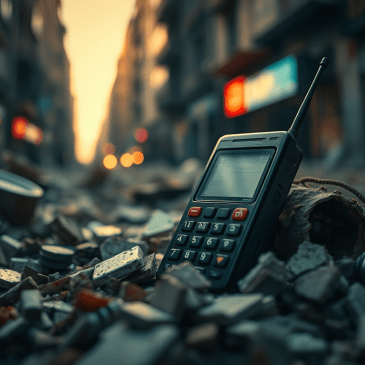
The Hidden Threat – Are Your Devices Truly Safe?
In the age of rapid technological advancements, the question of whether our devices are truly safe has taken center stage globally. The issue is no longer just about surveillance and eavesdropping; it’s about the more sinister possibility of weaponized gadgets that can pose life-threatening dangers to everyday users. The recent events in Lebanon, where numerous pagers exploded simultaneously, have raised concerns about the new and dangerous face of terrorism that the world may have to confront.
The simultaneous explosion of multiple pagers in Lebanon has left people bewildered and fearful. How did these pagers, once a popular communication device, turn into lethal weapons? Theories have emerged that either a factory flaw or external tampering—perhaps by Israeli intelligence—may have been responsible for planting explosive pagers in Lebanon. This unprecedented form of terrorism suggests that our reliance on everyday gadgets, from phones to laptops, could now become a potential risk.
In the 1990s, pagers briefly gained popularity in India and around the world, serving as messaging devices. While modern society has shifted towards smartphones and other devices, pagers have found niche uses in hospitals and restaurants, where quick, silent communication is needed. However, the Lebanon event shows that even the most innocuous electronic gadgets can be weaponized.
The implications are staggering. If pagers can be turned into bombs, then no electronic device—phones, laptops, even headphones—can be considered entirely safe anymore. Take the case of the Pegasus spyware, which can covertly record conversations, activate a phone’s camera even when it’s turned off, and monitor users without their knowledge. These developments should raise alarms about how vulnerable our personal devices are to malicious attacks.
Edward Snowden, the whistleblower who revealed the mass surveillance programs conducted by the U.S. government, has repeatedly warned about the risks posed by technology. In this particular case, if pagers were indeed rigged with explosives from their factories, Snowden’s concerns about the potential for large-scale harm through digital devices seem even more prescient. As he pointed out, these threats go beyond mere surveillance—devices can now be used for terror.
The Lebanese explosion echoes a darker trend where technology is being increasingly integrated into violent conflicts. One particularly chilling historical parallel comes from the 2005 film Munich by Steven Spielberg. The movie depicts Israel’s Mossad using a phone to assassinate Mahmoud Al-Hamsar, a member of the Palestinian Liberation Organization (PLO), by replacing his handset with an explosive device. When Hamsar answered the phone, it detonated, marking a brutal revenge by Israeli intelligence for the 1972 Munich Olympics massacre. Similarly, in 1996, an incident occurred where Hamas operatives were targeted with a Motorola Alpha phone rigged with 50 grams of explosives. As soon as the recipient picked up the phone, it exploded, highlighting how easily communication devices can be weaponized.
While the film Munich was criticized for equating counterterrorism actions with terrorism itself, it exposed an uncomfortable truth: violence and technological ingenuity in warfare are intertwined. The idea that no distinction exists between terrorism and counterterrorism in such scenarios becomes starkly evident when devices designed for communication are repurposed for destruction.
The implications of the Lebanon incident and the weaponization of devices are profound. If terrorists and state actors can turn everyday gadgets into tools of violence, then the lines between digital security, terrorism, and warfare become increasingly blurred. The event raises critical questions for policymakers and technology developers: how can we ensure that everyday electronic devices remain safe? Can we trust that our phones, laptops, or pagers won’t be tampered with by malicious actors, whether states or terror organizations?
Moreover, Snowden’s revelations about the U.S. National Security Agency’s (NSA) practices—where commercial shipments of electronic devices were intercepted and implanted with tracking devices—further exacerbate these concerns. His 2013 leaks, in collaboration with journalist Glenn Greenwald, revealed that the NSA was modifying electronics in transit to include surveillance capabilities, a practice that mirrors the fears raised by the Lebanon pager incident.
The pager explosions in Lebanon represent a dangerous precedent in the ongoing evolution of terrorism. In an increasingly connected world, where electronic devices are ubiquitous, the potential for these tools to be turned into weapons should not be underestimated. From smartphones that record and spy on us to pagers that explode without warning, the digital age is not just a time of convenience—it’s also a period where constant vigilance is required.
As we move forward, it is crucial that individuals and governments alike remain aware of the dangers posed by the intersection of technology and conflict. We must ask ourselves: can we truly trust the gadgets we carry with us every day? Or has the digital age ushered in a new era where the devices designed to connect us might one day tear us apart?


 CISSP Made Easy