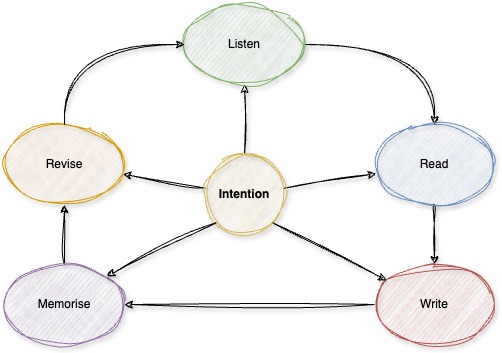
In the journey of acquiring knowledge, every step is significant, and each plays a vital role in the learning process. However, at the core of this journey lies a force that often goes unnoticed: intention. From the moment we decide to learn something new, intention acts as the driving force that propels us through each stage, making our efforts meaningful and effective. This cycle of learning involves several stages: intention, listening, reading, writing, memorizing, revising, and ultimately, returning to listening to complete the cycle. Let’s explore how intention interplays with each of these stages and how it guides us toward true understanding.
The Role of Intention in Learning
Intention is more than a mere wish to learn; it is a conscious and deliberate decision to engage with knowledge. It is the seed from which all learning activities sprout. In educational psychology, intention is closely linked to motivation, which influences the depth of learning. According to Carol Dweck’s research on the Growth Mindset, a learner’s belief in their ability to grow and improve is fueled by their intention to learn, leading them to persevere through challenges and ultimately achieve greater success .
Listening: Beyond Hearing
Listening is the first active step in the learning process. It differs from hearing in that it requires focus and the intent to understand. Effective listening involves processing the information being communicated, discerning its meaning, and making connections with prior knowledge. Daniel Goleman, in his work on Emotional Intelligence, emphasizes the importance of listening with empathy and attention, suggesting that it is crucial not only for learning but also for building meaningful relationships .
Reading: Engaging with Texts
Reading is an extension of listening, where the learner interacts with written content. Reading with intention means actively engaging with the text, asking questions, and seeking to understand rather than just passively absorbing information. Mortimer Adler’s classic How to Read a Book outlines how readers should approach texts with the goal of gaining a deeper understanding, advocating for a proactive and purposeful reading strategy .
Writing: Solidifying Understanding
Writing serves as a tool for reflection and consolidation of knowledge. When we write, we are not just transcribing information but are also organizing our thoughts and making connections between different concepts. Research by Dr. Robert A. Bjork on Desirable Difficulties suggests that writing, as a form of retrieval practice, enhances learning by forcing the brain to retrieve and structure information, making it more likely to be remembered and understood .
Memorizing: Building Mental Resilience
Memorizing is often seen as a rote activity, but when done with intention, it becomes a powerful way to internalize knowledge. Intention in memorization means understanding the purpose behind what is being memorized and connecting it to a broader context. Hermann Ebbinghaus’s research on The Forgetting Curve shows that intentional repetition over time (spaced repetition) significantly improves retention .
Revising: Reinforcing Knowledge
Revising is the act of revisiting what has been learned to reinforce it and to fill in any gaps in understanding. This stage is crucial for transforming short-term learning into long-term knowledge. According to The Feynman Technique, revision is most effective when done by teaching the material to someone else, as it forces the learner to clarify and simplify complex ideas .
Completing the Cycle: Returning to Listening
After revising, returning to listening allows the learner to hear familiar information with a fresh perspective, deepening their understanding. This cyclical nature of learning ensures continuous improvement and mastery of knowledge. The philosopher John Dewey, in his work on Reflective Thinking, argues that learning is not linear but a continuous cycle of reflection and action, where each stage builds upon the previous one .
Throughout this cycle, intention acts as a guide, ensuring that each stage is approached with purpose and focus. It is the thread that weaves through listening, reading, writing, memorizing, and revising, tying them together into a cohesive process of learning. By cultivating strong intention, learners can enhance their ability to absorb, retain, and apply knowledge, ultimately leading to a deeper and more fulfilling learning experience.
Islam places a strong emphasis on the pursuit of knowledge and the process of learning, motivating believers to engage in this cycle of learning with intention and purpose. Several key aspects of Islamic teachings encourage and align with the stages of the learning process:
1. Intention (Niyyah)
In Islam, every action begins with intention (niyyah). The Prophet Muhammad (peace be upon him) said,
“Actions are judged by intentions” (Hadith reported by Bukhari and Muslim).
This emphasizes that learning, like any other action, should be approached with a sincere intention to seek knowledge for the sake of Allah, to benefit oneself and others, and to improve one’s understanding of the world.
2. Listening (Ijtihad in Seeking Knowledge)
The Quran frequently encourages believers to listen, reflect, and act upon knowledge.
Surah Az-Zumar (39:18) praises those who “listen to the word, then follow the best of it.”
Listening with the intention to understand and apply knowledge is a form of ijtihad (striving in the path of knowledge), which is highly valued in Islam.
3. Reading (Iqra – The Command to Read)
The first word revealed in the Quran was “Iqra” (Read) (Surah Al-Alaq 96:1).
This command underscores the importance of reading and acquiring knowledge. The act of reading is considered an essential part of learning and understanding the signs of Allah in the universe and the teachings of Islam.
4. Writing (Recording Knowledge)
Writing is encouraged in Islam as a means to preserve and transmit knowledge.
The Quran (Surah Al-Baqarah 2:282) emphasizes the importance of documenting transactions, which extends to the broader context of recording knowledge to prevent loss and distortion.
Scholars throughout Islamic history have meticulously recorded knowledge, contributing to the preservation of Islamic teachings.
5. Memorizing (Hifz of Knowledge)
Memorization holds a special place in Islam, particularly in the preservation of the Quran. The practice of hifz (memorizing the Quran) is a deeply respected tradition, demonstrating the value placed on internalizing knowledge.
This process goes beyond rote memorization, as it requires understanding and applying the knowledge in daily life.
6. Revising (Tadhkir – Remembrance and Reflection)
The Quran and Hadith emphasize the importance of revising and reflecting on knowledge.
The Quran (Surah Al-A’la 87:9) instructs believers to “Remind, for indeed the reminder benefits the believers.”
Regular revision and reflection help in retaining and deepening understanding, which is crucial in the continuous pursuit of knowledge.
7. Returning to Listening (Continuous Learning)
Islam advocates for lifelong learning, with an emphasis on humility and the understanding that one can always learn more.
The Prophet Muhammad (peace be upon him) said, “Seek knowledge from the cradle to the grave.”
This teaching encourages believers to continuously engage in the cycle of learning, revisiting and reflecting on what they have learned to gain new insights.
In Islam, the pursuit of knowledge is a virtuous act, deeply rooted in the principles of intention, active engagement, and continuous learning. The alignment of Islamic teachings with the stages of the learning process motivates believers to approach learning with sincerity, purpose, and a commitment to apply what they learn in service to Allah and humanity. By integrating these principles, Muslims are encouraged to seek knowledge, reflect upon it, and use it to improve themselves and society.
 CISSP Made Easy