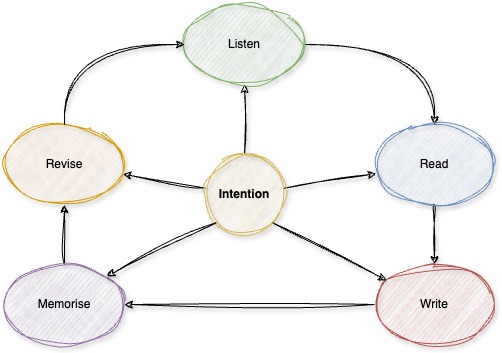
In the journey of acquiring knowledge, every step is significant, and each plays a vital role in the learning process. However, at the core of this journey lies a force that often goes unnoticed: intention. From the moment we decide to learn something new, intention acts as the driving force that propels us through each stage, making our efforts meaningful and effective. This cycle of learning involves several stages: intention, listening, reading, writing, memorizing, revising, and ultimately, returning to listening to complete the cycle. Let’s explore how intention interplays with each of these stages and how it guides us toward true understanding.
The Learning Cycle and the place of Intention
The Role of Intention in Learning
Intention is more than a mere wish to learn; it is a conscious and deliberate decision to engage with knowledge. It is the seed from which all learning activities sprout. In educational psychology, intention is closely linked to motivation, which influences the depth of learning. According to Carol Dweck’s research on the Growth Mindset, a learner’s belief in their ability to grow and improve is fueled by their intention to learn, leading them to persevere through challenges and ultimately achieve greater success .
Listening: Beyond Hearing
Listening is the first active step in the learning process. It differs from hearing in that it requires focus and the intent to understand. Effective listening involves processing the information being communicated, discerning its meaning, and making connections with prior knowledge. Daniel Goleman, in his work on Emotional Intelligence, emphasizes the importance of listening with empathy and attention, suggesting that it is crucial not only for learning but also for building meaningful relationships .
Reading: Engaging with Texts
Reading is an extension of listening, where the learner interacts with written content. Reading with intention means actively engaging with the text, asking questions, and seeking to understand rather than just passively absorbing information. Mortimer Adler’s classic How to Read a Book outlines how readers should approach texts with the goal of gaining a deeper understanding, advocating for a proactive and purposeful reading strategy .
Writing: Solidifying Understanding
Writing serves as a tool for reflection and consolidation of knowledge. When we write, we are not just transcribing information but are also organizing our thoughts and making connections between different concepts. Research by Dr. Robert A. Bjork on Desirable Difficulties suggests that writing, as a form of retrieval practice, enhances learning by forcing the brain to retrieve and structure information, making it more likely to be remembered and understood .
Memorizing: Building Mental Resilience
Memorizing is often seen as a rote activity, but when done with intention, it becomes a powerful way to internalize knowledge. Intention in memorization means understanding the purpose behind what is being memorized and connecting it to a broader context. Hermann Ebbinghaus’s research on The Forgetting Curve shows that intentional repetition over time (spaced repetition) significantly improves retention .
Revising: Reinforcing Knowledge
Revising is the act of revisiting what has been learned to reinforce it and to fill in any gaps in understanding. This stage is crucial for transforming short-term learning into long-term knowledge. According to The Feynman Technique, revision is most effective when done by teaching the material to someone else, as it forces the learner to clarify and simplify complex ideas .
Completing the Cycle: Returning to Listening
After revising, returning to listening allows the learner to hear familiar information with a fresh perspective, deepening their understanding. This cyclical nature of learning ensures continuous improvement and mastery of knowledge. The philosopher John Dewey, in his work on Reflective Thinking, argues that learning is not linear but a continuous cycle of reflection and action, where each stage builds upon the previous one .
Throughout this cycle, intention acts as a guide, ensuring that each stage is approached with purpose and focus. It is the thread that weaves through listening, reading, writing, memorizing, and revising, tying them together into a cohesive process of learning. By cultivating strong intention, learners can enhance their ability to absorb, retain, and apply knowledge, ultimately leading to a deeper and more fulfilling learning experience.
Islam places a strong emphasis on the pursuit of knowledge and the process of learning, motivating believers to engage in this cycle of learning with intention and purpose. Several key aspects of Islamic teachings encourage and align with the stages of the learning process:
1. Intention (Niyyah)
In Islam, every action begins with intention (niyyah). The Prophet Muhammad (peace be upon him) said,
“Actions are judged by intentions” (Hadith reported by Bukhari and Muslim).
This emphasizes that learning, like any other action, should be approached with a sincere intention to seek knowledge for the sake of Allah, to benefit oneself and others, and to improve one’s understanding of the world.
2. Listening (Ijtihad in Seeking Knowledge)
The Quran frequently encourages believers to listen, reflect, and act upon knowledge.
Surah Az-Zumar (39:18) praises those who “listen to the word, then follow the best of it.”
Listening with the intention to understand and apply knowledge is a form of ijtihad (striving in the path of knowledge), which is highly valued in Islam.
3. Reading (Iqra – The Command to Read)
The first word revealed in the Quran was “Iqra” (Read) (Surah Al-Alaq 96:1).
This command underscores the importance of reading and acquiring knowledge. The act of reading is considered an essential part of learning and understanding the signs of Allah in the universe and the teachings of Islam.
4. Writing (Recording Knowledge)
Writing is encouraged in Islam as a means to preserve and transmit knowledge.
The Quran (Surah Al-Baqarah 2:282) emphasizes the importance of documenting transactions, which extends to the broader context of recording knowledge to prevent loss and distortion.
Scholars throughout Islamic history have meticulously recorded knowledge, contributing to the preservation of Islamic teachings.
5. Memorizing (Hifz of Knowledge)
Memorization holds a special place in Islam, particularly in the preservation of the Quran. The practice of hifz (memorizing the Quran) is a deeply respected tradition, demonstrating the value placed on internalizing knowledge.
This process goes beyond rote memorization, as it requires understanding and applying the knowledge in daily life.
6. Revising (Tadhkir – Remembrance and Reflection)
The Quran and Hadith emphasize the importance of revising and reflecting on knowledge.
The Quran (Surah Al-A’la 87:9) instructs believers to “Remind, for indeed the reminder benefits the believers.”
Regular revision and reflection help in retaining and deepening understanding, which is crucial in the continuous pursuit of knowledge.
7. Returning to Listening (Continuous Learning)
Islam advocates for lifelong learning, with an emphasis on humility and the understanding that one can always learn more.
The Prophet Muhammad (peace be upon him) said, “Seek knowledge from the cradle to the grave.”
This teaching encourages believers to continuously engage in the cycle of learning, revisiting and reflecting on what they have learned to gain new insights.
In Islam, the pursuit of knowledge is a virtuous act, deeply rooted in the principles of intention, active engagement, and continuous learning. The alignment of Islamic teachings with the stages of the learning process motivates believers to approach learning with sincerity, purpose, and a commitment to apply what they learn in service to Allah and humanity. By integrating these principles, Muslims are encouraged to seek knowledge, reflect upon it, and use it to improve themselves and society.
Introduction: Welcome back, friends, to the ongoing series titled “Concepts of CISSP.” Today, we’re diving into Domain 3, which focuses on Security Architecture and Engineering. Before we explore this domain, let’s recap the foundational concepts covered in Domains 1 and 2.
Recap of Domain 1 and 2: In Domain 1, we laid the groundwork by discussing the principles of information security, including confidentiality, integrity, availability, non-repudiation, and authenticity. These principles are fundamental in shaping a security framework, which organizations use to design effective security policies. We also examined various governance strategies to ensure that security policies align with organizational goals.
Moving on to Domain 2, we delved into asset security, focusing on the lifecycle of data within an organization. We explored the security controls necessary to maintain the desired level of confidentiality, integrity, and availability (CIA).
Security Architecture and Engineering: Domain 3 takes us deeper into the realm of security by exploring the architecture and engineering aspects. These concepts might seem straightforward, but within the context of CISSP, they carry significant weight.
What is Security Architecture?
Security architecture is essentially the design and organization of components, processes, and services that form the backbone of a secure system. Think of it as creating a high-level blueprint or structural organization that outlines how security measures are integrated into a system.
What is Security Engineering?
While architecture involves the design phase, engineering is about implementation. It’s the process of putting the architectural blueprint into action using standard methodologies to achieve the desired security outcomes.
Key Principles in Security Architecture and Engineering: Understanding the principles of security architecture and engineering is crucial. Much like the principles of information security, these principles guide the design and implementation of secure systems.
Architectural Principles
Two major bodies of knowledge provide the foundation for security architecture principles:
Saltzer and Schroeder’s Principles:
Economy of Mechanism: Simplify design to reduce the likelihood of errors.
Fail-Safe Defaults: Default settings should deny access unless explicitly granted.
Complete Mediation: Ensure every access to every resource is checked.
Open Design: The security of a system should not depend on secrecy of design.
Separation of Privilege: Multiple conditions should be required for access.
Least Privilege: Grant the minimal level of access necessary for tasks.
Least Common Mechanism: Minimize the sharing of mechanisms between users.
Psychological Acceptability: User interfaces should be designed for ease of use.
ISO/IEC 19249:2017 Principles:
Domain Separation: Separate different areas of functionality.
Layering: Structure the system in layers to mitigate threats.
Encapsulation: Restrict access to specific information.
Redundancy: Implement backup components to ensure reliability.
Virtualization: Create virtual versions of physical resources for better security.
Trusted Systems and Reference Monitors
A trusted system is a computer system that can enforce a specified security policy to a defined extent. This system includes a crucial component called a Reference Monitor—a logical part of the system responsible for making access control decisions.
To be considered a trusted system, certain criteria must be met:
Tamper-Proof: The system should resist unauthorized alterations.
Always Invoked: The security controls must always be active.
Testable: The system should be small enough to allow for independent verification.
Conclusion: In Domain 3, we focus on dissecting and understanding security architectures rather than creating them from scratch. This approach allows CISSP professionals to evaluate and enhance existing systems, ensuring they meet the highest security standards. By understanding the principles of security architecture and engineering, you can design and implement robust security measures that align with organizational goals.
References:
Saltzer, Jerome H., and Michael D. Schroeder. “The Protection of Information in Computer Systems.” Proceedings of the IEEE, vol. 63, no. 9, 1975, pp. 1278-1308.
ISO/IEC 19249:2017. Information technology – Security techniques – Design principles for secure systems. International Organization for Standardization, 2017.
National Security Agency (NSA). “Trusted Computer System Evaluation Criteria (Orange Book).” Department of Defense, 1983.
This foundational knowledge will prepare you for the upcoming discussions on the principles of security engineering and how to apply them effectively in real-world scenarios. Stay tuned for more in-depth exploration!
Detailed Video discussion:
Hello friends, welcome back. Welcome to this series, which I named as Concepts of CISSP. This is Domain 3, and in Domain 3, we will be dealing with security architecture and engineering. Architecture and engineering sound interesting, but before we dive into Domain 3, I will just give you a very high-level, quick recap of Domain 1 and Domain 2.
So, what we studied in Domain 1 was the foundation that is going to be followed in the rest of the domains, right? We discussed the principles of information security and how these principles take shape in a security framework, and how the framework can be used to design the security policy of a specific company or organization. With that in mind, we then looked into different governance strategies and how these security policies can be set into action to achieve organizational business goals. That was the crux of Domain 1.
There are different security principles like confidentiality, integrity, availability, non-repudiation, and authenticity—these are what we studied in Domain 1. In Domain 2, we looked into asset security. In asset security, we specifically examined the lifecycle of data or information, how it flows in an organization, and the different security controls we put in place to ensure that we achieve the organization’s desired CIA levels.
Now, in Domain 3, we are going to study more about the different architectures and frameworks, and the security models we use to achieve the desired security outcomes of an organization. We’ll be dealing with two key terms here: architecture and engineering. We all have a rough idea of what architecture and engineering are, but if we look into the perspective of CISSP, we will see that security architecture and engineering—if we look into what is architecture—architecture is basically the design and organization of components, processes, and services, right? This is what security architecture is: we are designing and organizing it into some sort of structural organization, a high-level block diagram, and that gives rise to security architecture. So, when we talk about security architecture, we will be talking about components, processes, and services.
What is engineering? Engineering is basically the implementation part of security architecture. Implementation is not in the architecture; it’s the next phase of the overall security solution design. So first, we design, making a blueprint which is the architecture. What do we do in architecture? We design and organize components, processes, and services, and then we implement those using some standard methodology—that is the engineering methodology. This is what we are going to do in the coming discussions in Domain 3. There are more interesting things to come: we’ll be discussing the principles of engineering and architecture.
As we’ve seen with the principles of information security and how these principles give rise to a security framework or policy, similarly, we have to look into the different principles of security architecture and engineering, and how these can give rise to a secure system. The term architecture and engineering might give the impression that we are going to design some product, but when it comes to CISSP, and the CISSP exam specifically, we are not dealing with designing a security product. Our approach is a bit backward; we are dissecting the product or service to see how the security is engineered and implemented.
We should not have the idea that we are going to design a secure product. Designing a secure product also needs information or knowledge, which is part of the CISSP curriculum, but in the world where CISSP professionals operate, in the majority of the domains, it is basically the implementation. When we talk of the architecture, we are not architecting a semiconductor chip or a computer. That also requires a foundational understanding of how we architect something securely or how we implement something securely, but here we are using those blocks, those components, to achieve an organization’s security objectives.
Our understanding of architecture and implementation is like the way we architect a cloud service in Azure and AWS. We take different services and design in a Lego-like manner on Visio or a drawing board, then we see what security objectives we are going to achieve. This is the way we will approach it. We’ll discuss the principles, then how these principles are modeled using industry models, and how they are implemented.
If we go to my drawing board now, I have explained that security architecture and engineering are basically the design and organization of components, processes, and services. This is something you should keep in mind as a definition. When it comes to engineering, engineering is basically the implementation of the design and organization. Any creation we conceive and produce is a two-step process: first, we think of it and make some sort of blueprint, which is the architecture, and then we implement it. There’s a famous saying, “measure twice and hammer once.” So, a great deal of attention has to be given to the architecture phase of the process, and then we implement it. If we have given enough consideration, enough security concentration, in architecting a service, our implementation will be easy, with no rework. But if the architecture is rushed to achieve business objectives and security is sidelined, there will be many problems.
The process of security architecture in an organization or company follows three steps: first, we do a risk assessment, then we identify and agree on the identified risks, and then we address the risks using secure design. We go with standard security mitigation processes like accepting the risk, avoiding the risk, mitigating the risk, or transferring the risk. All these can be addressed with a secure design. The secure design addresses how we actually deal with the identified risks of a system or organization.
Now, secure design principles, as I already explained, go hand-in-hand with what we studied in Domain 1, where we have information security principles that take the form of a framework and give rise to a policy, which is used to govern the organization. Similarly, we have design principles here. When we talk about design principles, there are two major bodies of knowledge that produce these principles, which we should be aware of: one is Saltzer and Schroeder’s principles, and another is ISO/IEC 19249:2017’s set of design principles. We will look briefly into these principles and what they entail.
When it comes to Saltzer and Schroeder’s principles, there are eight architectural principles plus two more architectural principles borrowed from physical security. These eight architectural principles are: economy of mechanism, fail-safety, complete mediation, open design, separation of privilege, least privilege, least common mechanism, and psychological acceptability. The two additional principles, work factor and compromise recording, come from traditional physical security.
When it comes to ISO/IEC 19249 design principles, they differentiate between architectural principles and design principles. In architectural principles, they have five distinct principles: domain separation, layering, encapsulation, redundancy, and virtualization. For design principles, they have least privilege, attack surface minimization, centralized parameter validation, centralized general security services, and preparation for error and exception handling.
I explained that there are two major bodies of knowledge: ISO/IEC 19249 and Saltzer and Schroeder’s principles. You can refer to the official CBK book for more details on this, and we will be going into each principle to better understand how CISSP questions are framed around these principles.
Another major topic related to understanding design principles and design models is something called a trusted system. So, what is a trusted system? A trusted system is a computer system that can be trusted to a specified extent to enforce a specified security policy. It’s a theoretical concept. If you are creating any computer system or architecture that provides a service, a trusted system is one that can be trusted to a certain extent, as mentioned in the definition, to enforce a specified security policy. We can’t have a situation of 100% or 0% policy; we have to agree on a baseline, and that baseline will tell us what the specified security policy is. The level of trust we can have in the system is an attribute of the trusted system.
Now, the trusted system makes use of a term called reference monitor, which we should also know. So, what is a reference monitor? A reference monitor is basically an entity or a component of a trusted system. It is the logical part of the computer system and is responsible for all decisions related to access control. So, whenever you hear the term reference monitor, you should know that it is a component primarily dealing with access control to the trusted system. A reference monitor is a module, entity, or component of a trusted system that makes decisions regarding access control, such as who can access what resource, for how long, and with what privilege or authorization levels. This will be the topic of reference monitors.
Now, a trusted system has a reference monitor, and with that, there are certain expectations. The trusted system should be tamper-proof, always be invoked, which we will discuss more in Saltzer and Schroeder’s principle of complete mediation, and be small enough to be tested independently. If the trusted system is too large to test its firmware separately, it defies its purpose.
In 1983, the United States Department of Defense published the Orange Book, also called TCSEC (Trusted Computer System Evaluation Criteria). It describes the features and assurances that users can expect from a trusted system. It gives a sort of scale or benchmark to measure how trusted a system is or to what level a user can trust a system.
A trusted system, as I already explained, includes the concept of a trusted system, reference monitor, and the expectations from a trusted system. Now, with this trusted system, when it comes to TCSEC, they introduced the term trusted computing base (TCB). A trusted computing base is a combination of hardware, software, and firmware responsible for the security policy of an information system. You may have a system with functional parts, input/output, memory, CPU, and everything, but a portion of the system is responsible for its security. That portion is called the trusted computing base. The trusted computing base is a logical structure, and it has a lot to do with hardware, software, and firmware.
We need to know that any system can be divided into functional blocks and security blocks. The trusted computing base deals with the security block of the system. It enforces the security policy, and we can trust it to a certain level.
Now, as we saw in Domain 1, security controls can be administrative, physical, or technical. The administrative control comes from a trusted computing base, which is logical. The trusted computing base is where technical security controls reside, right? So, administrative controls are the administrative part of an organization; the trusted computing base gives technical controls. These technical controls are in the form of access controls, encryption, etc. They are found in the trusted computing base, which is logically part of the system.
The trusted computing base consists of a reference monitor, which we discussed earlier. The reference monitor must have a security kernel, which is a core component of the reference monitor. The security kernel is responsible for enforcing the security policy and should meet three essential conditions: isolation, verifiability, and mediation. Isolation means the security kernel must be isolated from the rest of the system, verifiability means it must be verifiable through independent testing, and mediation means it should mediate or control access to resources.
The security kernel is at the heart of the reference monitor, and the reference monitor is at the heart of the trusted computing base. This gives rise to a secure system, which is a combination of the trusted computing base, the security kernel, and the reference monitor. We need to understand this because questions in CISSP might test our understanding of how the trusted computing base, security kernel, and reference monitor work together.
One final thing we need to touch on is the different security models we use in security architecture and engineering. There are several models, but the main ones are the Bell-LaPadula model, the Biba model, the Clark-Wilson model, the Brewer-Nash model, and the Harrison-Ruzzo-Ullman model.
The Bell-LaPadula model focuses on maintaining data confidentiality and controls access to information based on security classifications. The Biba model is concerned with data integrity and prevents unauthorized users from modifying data. The Clark-Wilson model ensures that transactions are performed correctly, enforcing integrity through well-formed transactions and separation of duties. The Brewer-Nash model, also known as the Chinese Wall model, prevents conflicts of interest by restricting access to information based on the user’s previous interactions. The Harrison-Ruzzo-Ullman model focuses on access control and the management of user permissions.
We’ll discuss these models in more detail in future sessions, but it’s important to understand the basics of each model and how they contribute to security architecture and engineering. Each model has its strengths and weaknesses, and they are used in different contexts to achieve specific security objectives.
That concludes our overview of security architecture and engineering. In the next session, we’ll dive deeper into the principles of design and architecture, and we’ll explore how these principles are applied in real-world scenarios. Thank you for watching, and I look forward to continuing our journey through Domain 3 of the CISSP curriculum.
08:00 AM A group of sophisticated cybercriminals identifies a vulnerability in the CrowdStrike Falcon software, based on the incident from July 2024. They exploit an unpatched version running on the IT systems of a major metropolitan hospital and an international airline.
09:30 AM The attackers breach the hospital’s network through a compromised endpoint, gaining access to the internal systems. Simultaneously, they infiltrate the airline’s network, targeting critical operational systems.
11:00 AM Malware is quietly installed on both networks. The ransomware is set to initiate a coordinated attack designed to maximize disruption. The attackers spend the next few hours exploring the networks, identifying key systems, and ensuring they have control over backups and critical infrastructure.
Day 2: Attack Initiation
07:00 AM The ransomware is activated across the hospital’s network, encrypting patient records, diagnostic equipment, and critical medical databases. Simultaneously, the airline’s systems are attacked, with operational software and booking systems being encrypted.
07:15 AM Hospital staff discover that their systems are inaccessible. Alarms and diagnostic tools start malfunctioning, creating confusion and panic among medical personnel.
07:30 AM At the airline’s main hub, boarding systems, check-in kiosks, and flight scheduling systems fail. Flights are delayed, and passengers are left stranded, unaware of the unfolding cyberattack.
Day 3: Escalation and National Impact
08:00 AM News of the hospital’s IT outage spreads quickly. Emergency procedures are activated, and patients in critical care are transferred to other hospitals, causing strain on neighboring medical facilities.
09:00 AM The airline cancels all flights from major airports due to the ransomware attack. Passengers are stuck in terminals, causing massive delays and overcrowding. The airline’s customer service lines are overwhelmed with calls.
10:00 AM The attackers demand a ransom of $50 million in cryptocurrency to decrypt the hospital and airline systems. They threaten to release sensitive patient data and airline customer information if the ransom is not paid within 48 hours.
Day 4: Government and Public Response
08:00 AM The government issues a national emergency declaration. Cybersecurity experts from federal agencies are dispatched to assist in resolving the situation.
09:30 AM News outlets report on the ransomware attack, causing widespread public panic. The stock market reacts negatively, with shares in healthcare and airline industries plummeting.
11:00 AM Hospitals nationwide are put on high alert. The Department of Health and Human Services coordinates with other hospitals to manage the overflow of patients.
01:00 PM The airline’s CEO holds a press conference, apologizing for the disruptions and assuring the public that they are working to resolve the issue. The Federal Aviation Administration (FAA) is involved in managing the air traffic chaos.
Day 5: Crisis Management and Mitigation
08:00 AM Federal cybersecurity teams begin working with the hospital and airline to contain the ransomware spread and assess the damage. Efforts are made to restore critical systems using backup data.
10:00 AM The attackers release a sample of stolen data to demonstrate their seriousness. The hospital’s and airline’s reputations take a severe hit as the public fears for their personal information.
12:00 PM Negotiations with the attackers are initiated, but progress is slow. Alternative plans are developed to restore systems without paying the ransom.
04:00 PM A temporary workaround is implemented for the hospital to access basic patient care systems. The airline begins manually processing flight schedules to resume limited operations.
Day 6: Resolution Efforts and Aftermath
08:00 AM Federal agencies successfully decrypt parts of the ransomware. The hospital’s critical systems are gradually restored, although many patient records remain encrypted.
09:00 AM The airline resumes more flights, but a full recovery is still weeks away. Thousands of passengers are still affected, and compensations are being arranged.
12:00 PM Public health advisories are issued to mitigate the spread of misinformation and panic. Government officials hold briefings to reassure the public and outline steps being taken.
Day 7: Recovery and Reflection
08:00 AM Both the hospital and airline begin a thorough review of their cybersecurity measures. Plans for stronger defenses and better incident response strategies are developed.
10:00 AM The government announces a new cybersecurity initiative aimed at critical infrastructure protection, emphasizing the need for advanced threat detection and response systems.
02:00 PM The attack becomes a case study for cybersecurity experts worldwide, highlighting the importance of robust security protocols and the dangers of an expanded attack surface.
This fictional scenario, while hypothetical, demonstrates how vulnerabilities exposed in a significant incident like the CrowdStrike breach can lead to catastrophic consequences. The ripple effect of such an attack can disrupt essential services, create national chaos, and prompt a reevaluation of cybersecurity strategies across industries. It underscores the critical need for constant vigilance, advanced security measures, and comprehensive response plans to protect against the ever-evolving landscape of cyber threats.
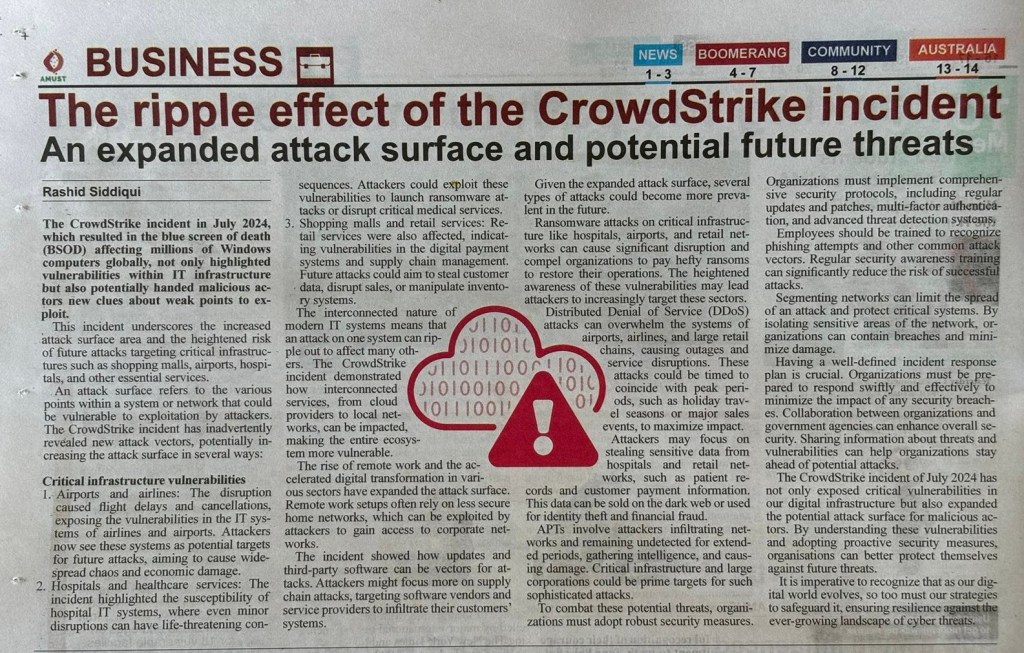
The CrowdStrike incident in July 2024, which resulted in the blue screen of death (BSOD) affecting millions of Windows computers globally, not only highlighted vulnerabilities within IT infrastructure but also potentially handed malicious actors new clues about weak points to exploit. This incident underscores the increased attack surface area and the heightened risk of future attacks targeting critical infrastructures such as shopping malls, airports, hospitals, and other essential services.
An attack surface refers to the various points within a system or network that could be vulnerable to exploitation by attackers. The CrowdStrike incident has inadvertently revealed new attack vectors, potentially increasing the attack surface in several ways:
Critical Infrastructure Vulnerabilities
Airports and Airlines: The disruption caused flight delays and cancellations, exposing the vulnerabilities in the IT systems of airlines and airports. Attackers now see these systems as potential targets for future attacks, aiming to cause widespread chaos and economic damage.
Hospitals and Healthcare Services: The incident highlighted the susceptibility of hospital IT systems, where even minor disruptions can have life-threatening consequences. Attackers could exploit these vulnerabilities to launch ransomware attacks or disrupt critical medical services.
Shopping Malls and Retail Services: Retail services were also affected, indicating vulnerabilities in the digital payment systems and supply chain management. Future attacks could aim to steal customer data, disrupt sales, or manipulate inventory systems.
Increased Interconnectivity
The interconnected nature of modern IT systems means that an attack on one system can ripple out to affect many others. The CrowdStrike incident demonstrated how interconnected services, from cloud providers to local networks, can be impacted, making the entire ecosystem more vulnerable.
Remote Work and Digital Transformation
The rise of remote work and the accelerated digital transformation in various sectors have expanded the attack surface. Remote work setups often rely on less secure home networks, which can be exploited by attackers to gain access to corporate networks.
Supply Chain Attacks
The incident showed how updates and third-party software can be vectors for attacks. Attackers might focus more on supply chain attacks, targeting software vendors and service providers to infiltrate their customers’ systems.
Potential Future Attacks
Given the expanded attack surface, several types of attacks could become more prevalent in the future:
Ransomware Attacks
Ransomware attacks on critical infrastructure like hospitals, airports, and retail networks can cause significant disruption and compel organizations to pay hefty ransoms to restore their operations. The heightened awareness of these vulnerabilities may lead attackers to increasingly target these sectors.
DDoS Attacks
Distributed Denial of Service (DDoS) attacks can overwhelm the systems of airports, airlines, and large retail chains, causing outages and service disruptions. These attacks could be timed to coincide with peak periods, such as holiday travel seasons or major sales events, to maximize impact.
Data Breaches and Theft
Attackers may focus on stealing sensitive data from hospitals and retail networks, such as patient records and customer payment information. This data can be sold on the dark web or used for identity theft and financial fraud.
Advanced Persistent Threats (APTs)
APTs involve attackers infiltrating networks and remaining undetected for extended periods, gathering intelligence, and causing damage. Critical infrastructure and large corporations could be prime targets for such sophisticated attacks.
Mitigating the Risks
To combat these potential threats, organizations must adopt robust security measures:
Enhanced Security Protocols
Organizations must implement comprehensive security protocols, including regular updates and patches, multi-factor authentication, and advanced threat detection systems.
Employee Training and Awareness
Employees should be trained to recognize phishing attempts and other common attack vectors. Regular security awareness training can significantly reduce the risk of successful attacks.
Network Segmentation
Segmenting networks can limit the spread of an attack and protect critical systems. By isolating sensitive areas of the network, organizations can contain breaches and minimize damage.
Incident Response Planning
Having a well-defined incident response plan is crucial. Organizations must be prepared to respond swiftly and effectively to minimize the impact of any security breaches.
Collaboration and Information Sharing
Collaboration between organizations and government agencies can enhance overall security. Sharing information about threats and vulnerabilities can help organizations stay ahead of potential attacks.
Conclusion
The CrowdStrike incident of July 2024 has not only exposed critical vulnerabilities in our digital infrastructure but also expanded the potential attack surface for malicious actors. By understanding these vulnerabilities and adopting proactive security measures, organizations can better protect themselves against future threats. It is imperative to recognize that as our digital world evolves, so too must our strategies to safeguard it, ensuring resilience against the ever-growing landscape of cyber threats.
Important References
“Security Engineering: A Guide to Building Dependable Distributed Systems” by Ross Anderson
“Building Secure and Reliable Systems: Best Practices for Designing, Implementing, and Maintaining Systems” by Heather Adkins, et al.
“Zero Trust Networks: Building Secure Systems in Untrusted Networks” by Evan Gilman and Doug Barth
Research Paper: “Network Segmentation: Architecture and Use Cases” by the SANS Institute


 CISSP Made Easy